AJCCA Advancing Trusted Cybersecurity at Its 3rd Annual Conference in Bangkok
Advancing Trusted Cybersecurity through the Agentic AI Era and Regional Collaboration.
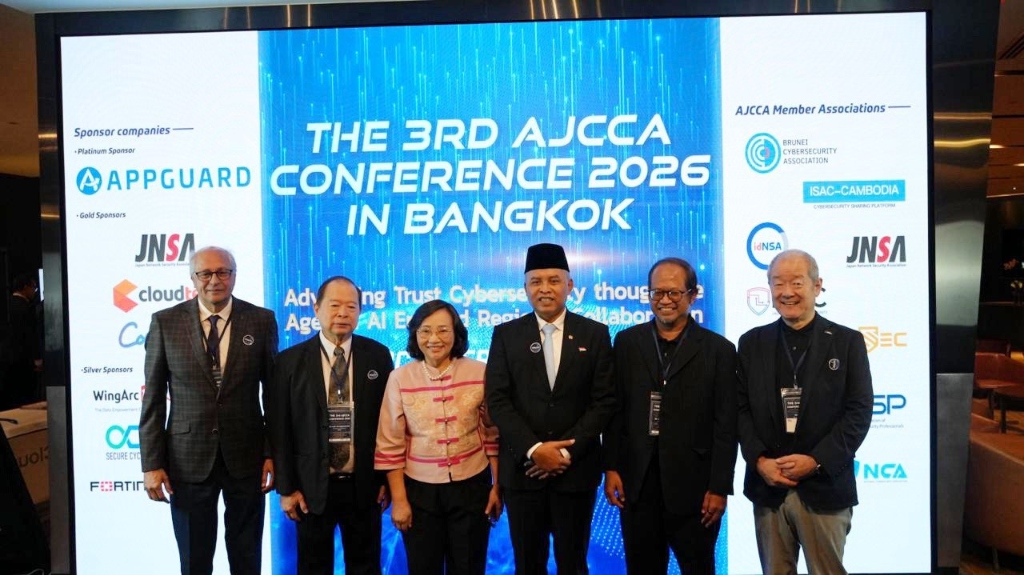
Bangkok, Thailand, October 29, 2026 — The ASEAN Japan Cybersecurity Community Alliance (AJCCA) successfully held its 3rd Annual Conference at the Crowne Plaza Hotel in Bangkok, Thailand, bringing together cybersecurity leaders, government officials, industry representatives, academics, and cybersecurity communities from across ASEAN, Japan, and beyond.
Under the theme “Advancing Trusted Cybersecurity through the Agentic AI Era and Regional Collaboration,” the conference highlighted the growing importance of regional cooperation in addressing increasingly sophisticated cyber threats, particularly those emerging from the rapid development of artificial intelligence.
The conference was hosted by the Thailand Information Security Association (TISA), one of AJCCA's founding communities, and co-hosted by Chulalongkorn Business School, Chulalongkorn University.
AI Is Transforming the Cybersecurity Landscape
In his welcome remarks, Dr. Rudi Lumanto, Chairman of AJCCA, emphasized that the world is entering a new era in which artificial intelligence is becoming increasingly autonomous, fundamentally changing both the opportunities and challenges facing cybersecurity.
“We are entering a new era where artificial intelligence is no longer just a tool that answers questions. AI is becoming more autonomous. It can make decisions, perform tasks, and take actions with limited human intervention,” Rudi said.
He explained that while these developments create tremendous opportunities for innovation and productivity, they also introduce new cybersecurity challenges.
“Cybercriminals are also using AI to accelerate their attacks, discover vulnerabilities, automate malicious activities, and create more sophisticated threats. The speed of cyberattacks is increasing, and our defense must become faster, smarter, and more collaborative,” he added.
Highlighting the urgency of these emerging challenges, Rudi referred to a Reuters report published in October 2026 concerning an AI-agent-driven hacking campaign reportedly involving more than 1,200 targeted websites and over 100 compromised companies.
The reported incident illustrated how cyberattacks are evolving beyond traditional methods, becoming increasingly autonomous, scalable, and affordable for malicious actors.
“This is a powerful warning. Cyberattacks are no longer just becoming more sophisticated. They are becoming increasingly autonomous, scalable, and affordable,” Rudi emphasized.
Cybersecurity Requires More Than Technology
Despite the growing role of artificial intelligence in both cyberattacks and cyber defense, Rudi stressed that technology alone cannot guarantee cybersecurity or digital resilience.
“However, I believe technology alone will never be enough. We need skilled people. We need strong institutions. We need cooperation between governments, industries, academia, and cybersecurity communities,” he said.
He emphasized that cybersecurity resilience must be built through collective efforts involving multiple stakeholders, supported by continuous capacity building, information sharing, and trusted regional partnerships.
This vision reflects AJCCA's commitment to strengthening cybersecurity cooperation across ASEAN and Japan through its various programs, including capacity building, threat intelligence exchange, strategic communication, and business matching.
Bringing Together Cybersecurity Leaders from ASEAN, Japan, and Beyond
The conference featured distinguished keynote speakers representing major national and regional cybersecurity institutions, including a senior representative of Thailand's National Cyber Security Agency (NCSA), the Head of Indonesia's National Cyber and Crypto Agency (BSSN), a representative of Japan's National Cybersecurity Office (NCO), and the Chairman of the Asian-Oceanian Computing Industry Organization (ASOCIO).
The conference also brought together prominent speakers and experts from cybersecurity-related ministries and government agencies across ASEAN, Chulalongkorn University, the World Economic Forum (WEF), and leading technology and cybersecurity industries.
Through keynote presentations, expert discussions, and networking sessions, participants exchanged perspectives on the evolving cybersecurity landscape, the implications of agentic AI, and the importance of strengthening regional preparedness and resilience.
The diverse participation demonstrated the increasingly interconnected nature of cybersecurity challenges and the need for stronger collaboration among governments, industries, academia, and professional communities.
Strengthening Regional Networks and Trusted Collaboration
Beyond the exchange of knowledge and perspectives, the 3rd AJCCA Annual Conference served as an important platform for building stronger relationships among cybersecurity stakeholders.
The event provided opportunities for government representatives, industry leaders, academics, and cybersecurity communities to establish new connections, explore potential collaboration, and strengthen existing partnerships.
These interactions reinforced AJCCA's belief that effective cybersecurity cannot be achieved by individual organizations or countries working in isolation.
As digital infrastructure, cloud services, financial systems, and critical information infrastructure become increasingly interconnected, cyber incidents in one organization or country can have consequences far beyond national borders.
Regional collaboration, therefore, is no longer simply an option but an essential component of building collective cyber resilience.
Through its growing network, AJCCA aims to bridge gaps between policy, technology, expertise, and operational capabilities, ensuring that cybersecurity cooperation produces tangible benefits for its members and the wider digital ecosystem.
Advancing a More Resilient Digital Future
The successful organization of the 3rd Annual Conference marked another important milestone in AJCCA's journey to strengthen cybersecurity collaboration between ASEAN and Japan.
The conference reinforced the importance of developing trusted partnerships, strengthening institutional capabilities, and preparing cybersecurity professionals and organizations for the challenges of the agentic AI era.
More importantly, it demonstrated that the future of cybersecurity will depend not only on technological innovation but also on the ability of governments, industries, academia, and communities to work together.
As AJCCA continues to expand its regional and international network, the Alliance remains committed to promoting practical collaboration, knowledge exchange, and collective action toward a safer and more resilient digital future.
The conference concluded with a clear message: trusted cybersecurity is built not only through advanced technology, but through stronger people, stronger institutions, and stronger regional collaboration.