AJCCA Expands Its Network Through MoU Signing with ATCI
Strengthening collaboration between the cybersecurity community and the ICT industry across ASEAN and Japan.
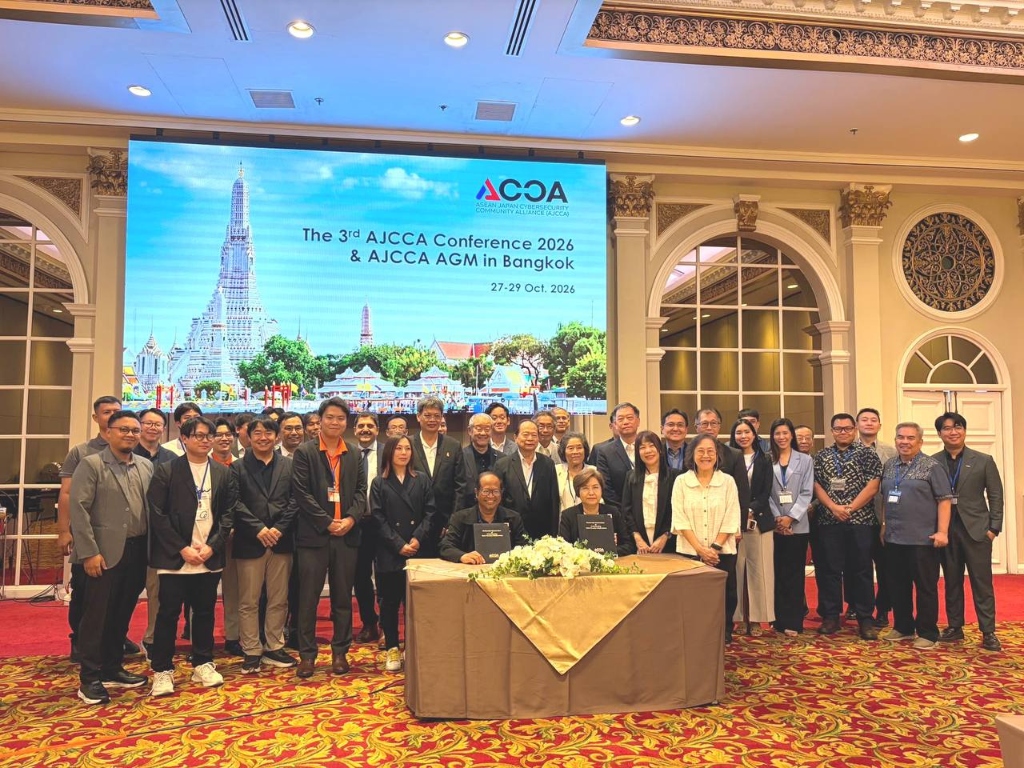
Bangkok, Thailand — The ASEAN Japan Cybersecurity Community Alliance (AJCCA) continues to expand its regional and global network through the signing of a Memorandum of Understanding (MoU) with the Association of Thai ICT Industry (ATCI), strengthening collaboration between the cybersecurity community and the ICT industry.
The MoU was signed as part of AJCCA’s continuing effort to build stronger connections among cybersecurity communities, technology industries, governments, academia, and other stakeholders across ASEAN, Japan, and beyond.
In her remarks, Ms. Kobkanjana Veerapongpradit, Vice President of ATCI, emphasized the importance of closer collaboration between the ICT industry and cybersecurity communities.
She noted that such cooperation should go beyond raising cybersecurity awareness and exchanging information. It should also create opportunities for organizations and companies to establish new partnerships and explore business opportunities at both regional and global levels.
Rudi Lumanto, Chairman of AJCCA, said that the MoU with ATCI marks AJCCA’s third MoU signed this year, reflecting the Alliance’s continued expansion of its strategic partnership network.
The signing was held alongside the implementation of AJCCA Business Matching, one of the Alliance’s programs designed to connect cybersecurity needs with relevant expertise, technologies, services, and potential partners.
According to Rudi, Business Matching was developed to complement another important AJCCA initiative, the Threat Intelligence Working Group.
“Business matching complements threat intelligence. If threat intelligence tells us what problem we need to address, business matching can help identify who can help us address it,” Rudi said.
He explained that threat intelligence enables organizations and cybersecurity communities to better understand emerging threats, vulnerabilities, attack trends, and areas requiring attention. Business Matching provides a complementary mechanism by connecting those identified needs with organizations that may have the appropriate expertise, technology, products, or services.
“It connects needs with expertise, problems with solutions, and organizations with suitable partners,” Rudi added. “The two mechanisms reinforce each other: Threat intelligence identifies the need, while business matching helps mobilize the capability.”
This approach reflects AJCCA’s broader objective of turning regional cybersecurity collaboration into practical action. By combining information sharing and threat intelligence with industry engagement and business collaboration, AJCCA aims to strengthen not only cybersecurity awareness but also the capacity of organizations across the region to respond to evolving cyber risks.
The partnership with ATCI is also expected to provide a stronger bridge between AJCCA’s cybersecurity community network and Thailand’s ICT industry, opening opportunities for knowledge exchange, joint activities, technology collaboration, and business partnerships across ASEAN and Japan.
With the signing of the ATCI MoU, and as AJCCA approaches its third Annual Conference, the Alliance has now established partnerships with six global partners, further expanding an international network that supports cybersecurity collaboration, capacity building, threat intelligence exchange, and industry engagement.
Through these partnerships, AJCCA continues to advance its mission of building a more connected and resilient cybersecurity ecosystem across ASEAN and Japan, while creating stronger links between cybersecurity challenges and the people, organizations, and technologies capable of addressing them.